Scene Detail Guides #10 Shrine Details
Human-crafted distinctions, enhanced through AI-assisted analysis.
Does your scene sound real?
A convincing shrine scene is not built from torii gates, stone paths, and sacred buildings alone.
It is the choro-choro of the purification basin, the soyo-soyo of an atmospheric breeze, the ritual shan-shan of a shrine maiden, and above all, the natural, unscripted movement of background characters.
This volume examines how Japanese mimetic expressions appear within the environment and how they shape its atmosphere.
Using the wrong expression does not simply sound unnatural.
It changes how the environment is perceived.
This is not a dictionary.
This is a field guide to lived environments.
Scene Detail Guides is a mapped record of how Japanese mimetic expressions appear throughout specific environments.
Rather than organizing mimetic words by meaning, each volume begins with a scene and traces the sounds, movements, textures, and perceptual shifts that naturally occur within it.
The aim is not to recommend expressions for a scene, but to help creators understand what people notice, ignore, and respond to as they move through it.
Scene Observation Notes (from Scene Detail Guides #10)
Mob Perception Flow
As the torii comes into view, attention settles on its shape and the narrow stone path leading inward. A small cluster of doubts surfaces—was the center off limits, had a bow been made at the gate—questions born less from faith than from not wanting to appear wrong in front of others. Passing beneath the gate, the air shifts slightly (saa / soyo-soyo), ...
Perceptual Boundary Field
Within the shrine boundary, modern noise fades from awareness. An ambulance’s pi po pi po or the rumble of a train may exist physically, but during the approach and prayer they do not register; the space filters them out. Once the prayer is finished—when thoughts drift toward lunch—those outside sounds return, and the sense of enclosure loosens. Crowd noise such as zawa-zawa does not belong here except during festivals or New Year. Even with many visitors...
Inside this guide
- Scene Snapshot — A scene-level overview of the environment and its sensory texture
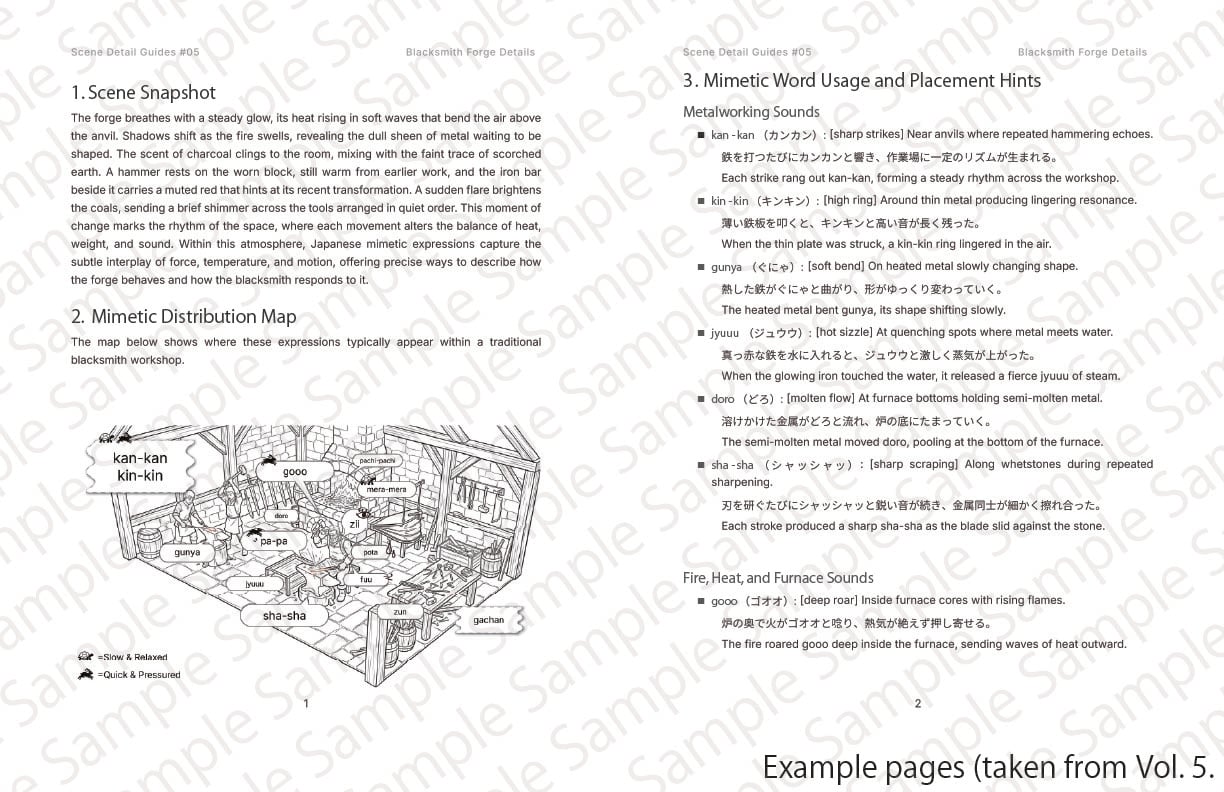
- Mimetic Distribution Map — An infographic showing where expressions naturally appear within the space
- Mimetic Word Usage and Placement Hints — Expressions commonly found in the environment, with placement guidance and examples
- Scene Dynamics — How expression choice shifts between relaxed and pressured situations
- Scene Observation Notes — Records of attention flow, perceptual boundaries, and environmental filtering within the scene
Who this guide supports
- Translators preserving environmental nuance
- Manga and anime creators constructing believable backgrounds
- Game developers designing lived-in spaces
- Writers who want scenes to feel inhabited rather than described
Don't just place NPCs.
Make them belong there.
This volume is part of the onowords Boundary Analysis Project, an ongoing effort to document the sensory boundaries, physical presence, and narrative behavior of Japanese mimetic expressions.