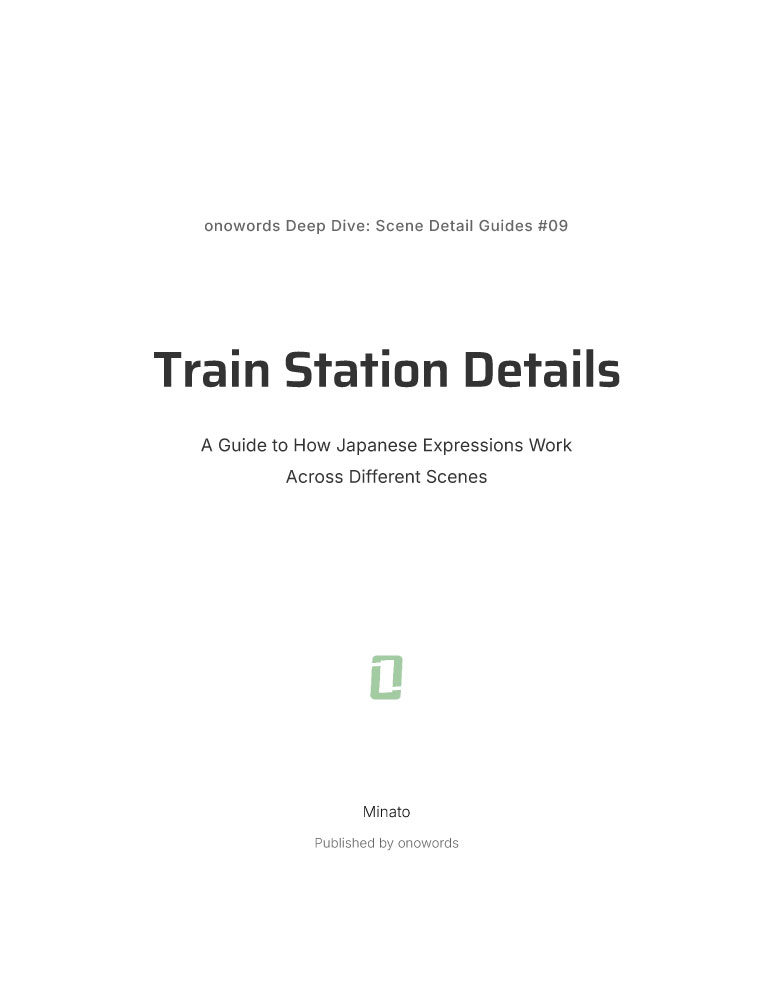
Scene Detail Guides #09 Train Station Details
Human-crafted distinctions, enhanced through AI-assisted analysis.
Does your scene sound real?
A train station scene isn’t shaped by platforms, rails, or the steady drift of commuters alone. Its tension comes from the thin boundaries between Japanese SFX—those small sounds that tighten the air when bodies shift direction or pause without warning. I do not treat these expressions as labels for noise; I watch how they behave when the station tilts from loose waiting to compressed movement.
This volume is a close-up tracking of the platform. I wanted to capture the moment when the low vibration inside the tunnel gathers weight and begins to press against the rails, just before the train appears. There is a clear atmospheric line between the drifting murmur of zawa-zawa and the sudden rise of a voice calling moshi-moshi as someone steps aside to answer a phone. Even the thin gust of hyuu along the platform edge has a point where it stops being background air and becomes the first sign of a train forcing its way in.
I do not give you generic definitions. I give you the exact physical weights, moving rhythms, and emotional temperatures of language.
This is not a dictionary.
This is a field guide to atmosphere.
Most guides simply list words. onowords DeepDive: Scene Detail Guides is born from a meticulous obsession with the sensory behavior of Japanese sound symbolism. Every explanation is isolated and weighed to help you portray atmosphere with absolute, cold precision.
Format & Usability
- Print-Ready Reference — Designed with a clean, fixed layout that translates beautifully to paper. Print out individual scene sheets to pin above your desk, bind them into a physical reference folder, or keep them on your tablet for immediate, distraction-free scanning while you create.
- Production-Ready & Fully Searchable — Effortlessly digital, yet built for practical environments. Keep the fully searchable PDF open on your second screen or translation workspace for instant keyword reference without breaking your creative rhythm.
Anatomy of the Boundary
Why does a technically correct scene sometimes feel lifeless? Because atmosphere is not built from objects alone. It emerges from the interaction of sound, motion, temperature, and pressure.
From Snapshot to Storytelling
This guide is built for fast creative workflows. Pure substance. No generic definitions.
You will see exactly how Japanese sound symbolism operates inside a real, moving scene—how natural vs. unnatural usage alters the emotional temperature, and how selecting the right SFX can force a moment from calm to tense in a single beat.
Inside this guide
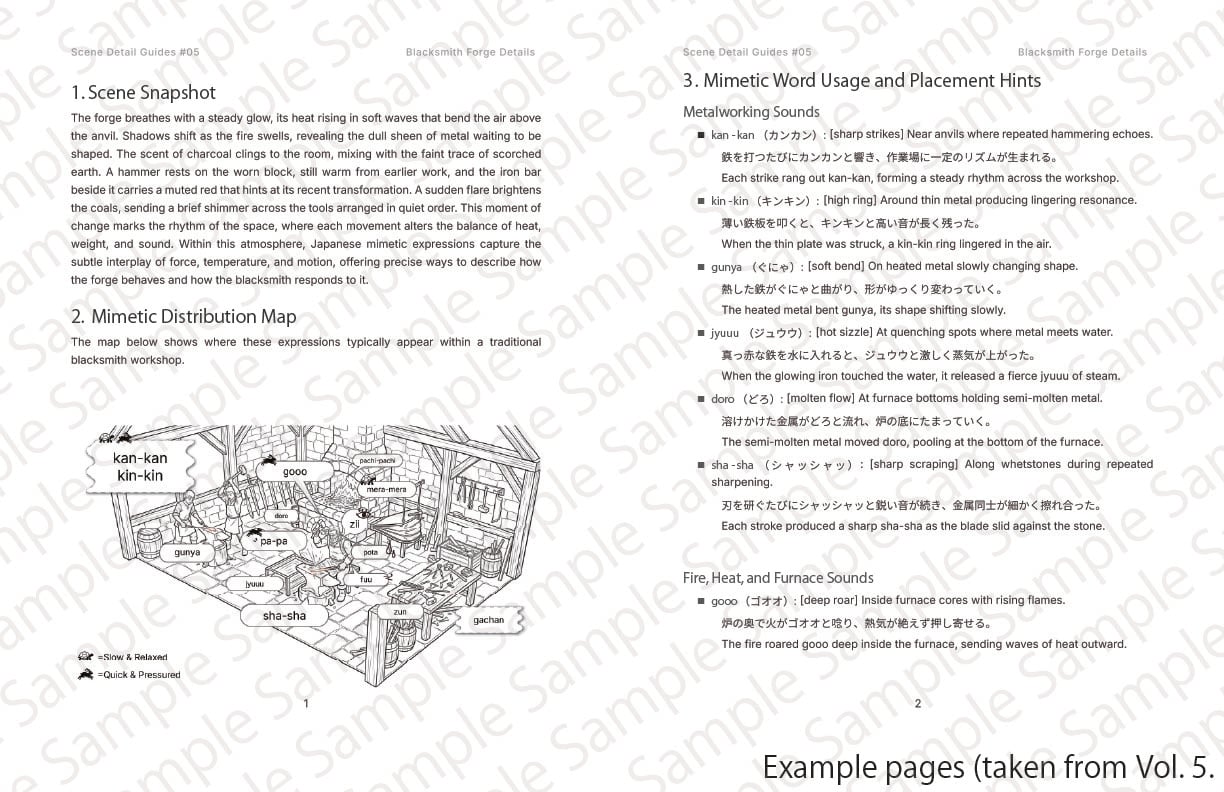
- Scene Snapshot – A vivid prose example showing how Japanese SFX and ideophones weave seamlessly into a professional narrative, shifting the room's atmosphere from stillness to motion.
- Mimetic Words in Action – Hand‑picked, highly specific expressions. Each word—from the sharp, high-velocity friction of gari-gari to the heavy, dense impact of ba-tan—is paired with ready‑to‑use example sentences and accurate English context.
- Scene Dynamics – Master the crucial tempo shift between Slow & Relaxed environments and Quick & Pressured settings, ensuring your sensory details always match the psychological pressure of your story.
Who keeps this guide open?
- Translators trying to preserve the temperature of a scene.
- Manga artists looking for the exact pressure behind a moment.
- Writers who know something feels wrong, but cannot yet identify which sensory layer has collapsed.
- Advanced learners interested in how Japanese builds atmosphere beyond vocabulary.
Don’t just translate the words. Portray the atmosphere.
Part of the onowords DeepDive series—compact references for creators who value clarity, precision, and expressive power.