Mimetic Example Guides #01 Movement & Action
Human-crafted distinctions, enhanced through AI-assisted analysis.
Then mimetic words may be one of the biggest hidden traps in your Japanese.
Take seka-seka, for example.
彼はせかせか走っていった。
He ran off with oddly restless, fidgety energy.
At first glance, the sentence seems acceptable. Even native speakers — and modern AI systems — may not immediately notice the friction. seka-seka evokes small, restless movements: hurried steps, nervous pacing, constant fidgeting. Used with running, the image becomes awkward unless the movement itself is unusually tiny or frantic.
Mimetic words are not defined only by meaning. They carry physical scale, texture, rhythm, emotional tone, and sensory imagery — boundaries that native speakers follow intuitively but rarely explain directly.
This guide traces those invisible boundaries in detail.
This is not a dictionary.
This is a linguistic dissection.
To map these boundaries, AI is used to generate large pools of candidate sentences, but the final distinctions and judgments remain entirely human-driven. onowords DeepDive: Mimetic Example Guides examines 15 essential mimetic words in each volume through a structured three-stage approach:
The Three-Stage Approach
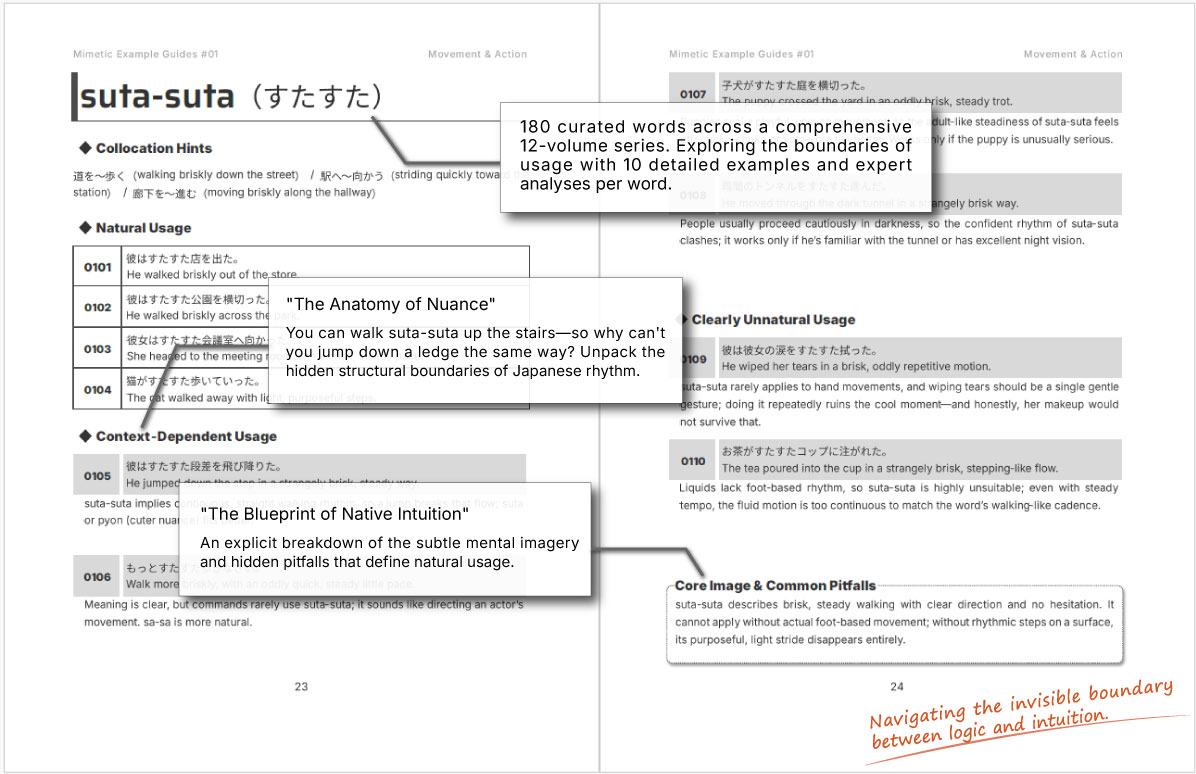
Natural Usage — Clear, natural examples that establish the standard usage and intuitive feel of the word.
Context-Dependent Usage — Expressions that may sound unusual at first, but become vivid, poetic, or highly effective in the right context. Many of these usages can even appear “correct” to advanced AI systems despite sounding subtly unnatural in ordinary speech.
Clearly Unnatural Usage — Sentences where the imagery breaks down completely, revealing the semantic and sensory limits of the word.
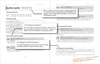
Inside Each Entry
Collocation Hints — Common pairings and usage patterns for practical application.
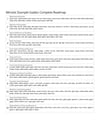
10 Nuanced Examples — Carefully designed examples ranging from fully natural usage to intentionally distorted or impossible combinations.
Core Image & Common Pitfalls — Understand the sensory image, intuitive boundaries, and frequent learner mistakes associated with each word.
Format & Usability
High-Fidelity PDF Format — Unlike standard reflowable e-books, this universal PDF layout preserves crisp typography, clean spacing, and pixel-perfect design on any screen.
Production-Ready & Fully Searchable — Perfectly optimized for dual-screen workflows. Keep it open alongside your text editor, clip studio, or design software. Easily search, reference, and integrate native nuances into your creative pipeline instantly.
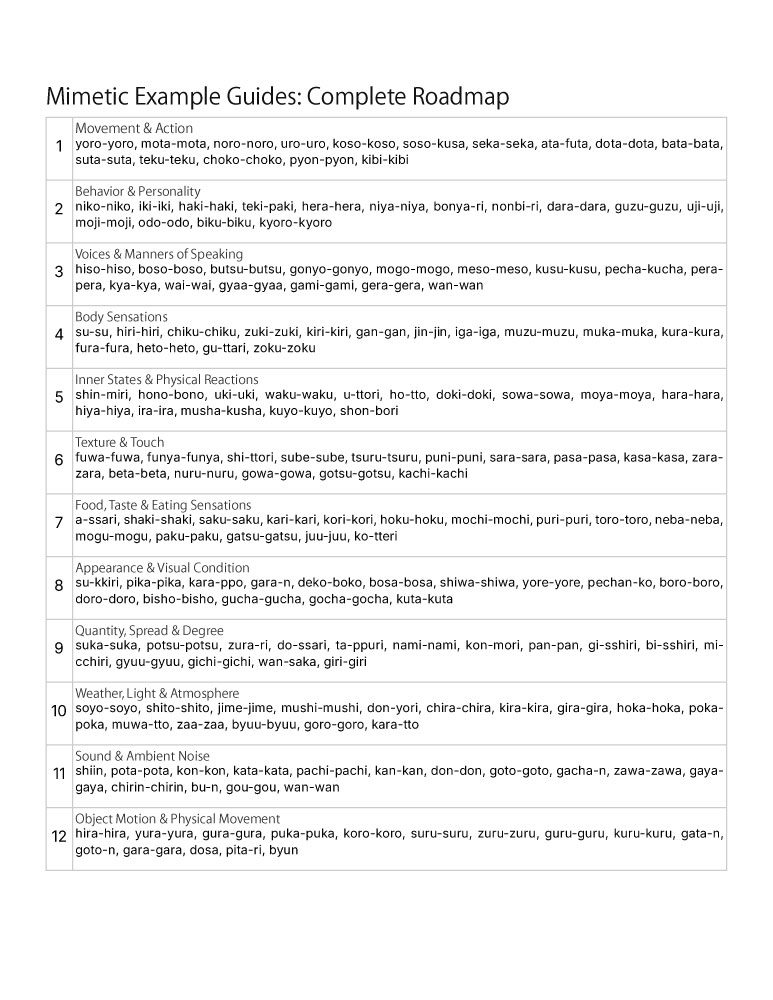
This series is part of a 12-volume collection covering 180 carefully selected Japanese mimetic words. Designed for intermediate and advanced learners, translators, writers, and creators seeking deeper control over nuance, tone, and native-level expression.
Don’t just memorize mimetic words. Learn where they truly work — and where they quietly fall apart.
Words featured in this volume:
yoro-yoro, mota-mota, noro-noro, uro-uro, koso-koso, soso-kusa, seka-seka, ata-futa, dota-dota, bata-bata, suta-suta, teku-teku, choko-choko, pyon-pyon, kibi-kibi